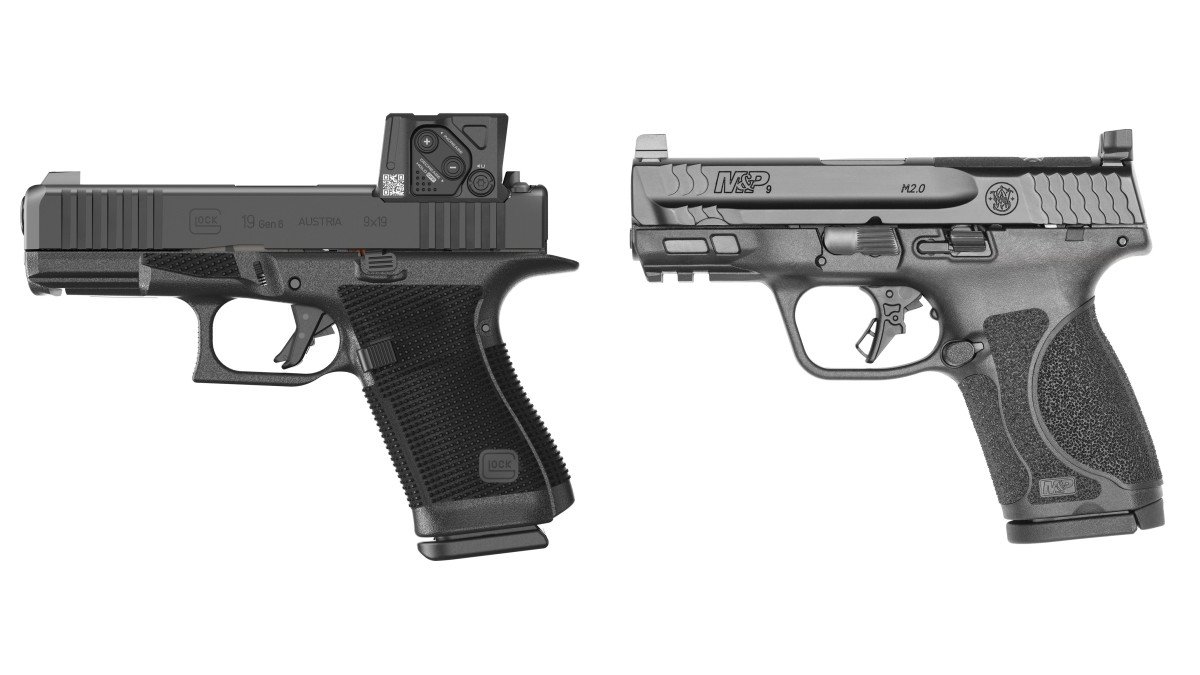
Glock or Smith & Wesson is the question we hear most often at the handgun counter in Grafton, and the honest answer is that both make a reliable 9mm you can carry for twenty years. We sell both, we carry both, and we have taken both apart on the bench. This guide lays out where they actually differ: how they feel in the hand, the triggers, safeties, optics cuts, the lineups side by side, and which one tends to suit which buyer. It ends with what is in the case at D&A Armory so you can handle them back to back, which settles the argument faster than any article.
The short answer
- Pick the one that points naturally for you. The grip angle and grip shape are the biggest real difference, and only your hand can judge them.
- Want a manual thumb safety? Smith & Wesson sells most M&P models with or without one. Glock does not offer one.
- Want the biggest aftermarket and the most holster choices? Glock, by a wide margin, though the M&P is well supported.
- Want a tunable grip out of the box? The M&P M2.0 ships with four palmswell inserts; Glock Gen 5 and Gen 6 pistols ship with interchangeable backstraps.
- Buying a first gun? Either. Shoot both if you can, then buy the one you shot better and practice with it.
What the two companies are known for
Glock built its reputation on one idea done well: a polymer-framed, striker-fired pistol with very few parts, the same controls on every model, and a record of running dirty, cold and neglected. The design has changed slowly. Gen 5 dropped the finger grooves and added an ambidextrous slide stop and a flared magazine well. Gen 6, which reached dealers in January 2026 for the G17, G19 and G45, is the biggest update in years: a new RTF-6 grip texture with built-in palm swells, interchangeable backstraps, an integrated beavertail, a flat-faced trigger, and a new Optic Ready System (ORS) that mounts a red dot without the old MOS adapter plates. Gen 6 still takes the standard double-stack 9mm magazines you may already own.
Smith & Wesson is the older company and makes a far broader catalog, from J-frame revolvers to the M&P line that competes head-on with Glock. The current M&P9 M2.0 has a steel chassis inside the polymer frame, an aggressive grip texture, four interchangeable palmswell inserts, a flat-faced trigger on current production, and a choice of a thumb safety or no thumb safety on most models. Below the M2.0 sit the carry guns: the Shield Plus, the Shield X and Carry Comp models, the Equalizer and the hammer-fired CSX, plus the Bodyguard 2.0 in .380. If Glock wins on simplicity, Smith & Wesson wins on choice.
How they feel in the hand
This is where most people decide, usually within ten seconds of picking each one up. The Glock grip sits at a steeper angle than most other pistols, and the gun has a blocky, upright feel. Some shooters find the sights land exactly where they look; others find the muzzle points high and they have to consciously roll their wrist down. The M&P grip angle is closer to a 1911, with a higher undercut behind the trigger guard and a more rounded backstrap, and a lot of people who never got along with a Glock pick up an M&P and feel at home immediately. The reverse is also true. Neither is better. One of them matches the way your hand already works.
Both brands let you adjust the fit. The M2.0 palmswell inserts change the depth of the grip and the reach to the trigger, and the small insert makes a full-size M&P workable for smaller hands. Glock backstraps add material rather than removing it, so a Glock is at its slimmest with no backstrap fitted, and Gen 6 builds the beavertail into the frame itself. Texture is a matter of taste: the M2.0 is one of the grippiest factory frames sold, which is wonderful with sweaty hands and a little abrasive against bare skin when you carry inside the waistband. Gen 5 Glocks are smoother; the Gen 6 RTF-6 texture splits the difference.
Triggers and safeties
Glock’s Safe Action trigger has a small blade in the face of the trigger plus internal firing pin and drop safeties, and no manual safety. The pull has a bit of take-up, a defined wall and a short, tactile reset, and it feels the same on every Glock ever made, which is a real advantage if you own several. Gen 6 moves to a flat-faced trigger shoe with the trigger sitting slightly closer to the grip, which shortens the travel.
Smith & Wesson’s M2.0 trigger has a lighter, crisper break than the original M&P did, and the reset is audible and positive. On current M2.0 and Shield Plus pistols the trigger is flat-faced too. The bigger difference is the option of a frame-mounted thumb safety. If you grew up on a 1911, carry with children in the house, or simply want a safety you can feel, Smith & Wesson gives you the choice on most models; look for TS or NTS in the product name. The Equalizer and the Shield EZ add an easy-rack slide and a grip safety for shooters with less hand strength, and the CSX is a hammer-fired single action with a thumb safety for people who want a metal-framed carry gun.
The lineups side by side
Most buyers are choosing between a specific pair of guns rather than two brands. These are the usual match-ups, with factory barrel lengths and the standard magazine capacity sold in Ohio.
| Role | Glock | Smith & Wesson | What separates them |
|---|---|---|---|
| Full size, 9mm | G17 Gen 6, 4.49 in, 17 rounds | M&P9 M2.0, 4.25 in, 17 rounds | Grip angle, thumb safety option on the M&P, Glock’s larger aftermarket |
| Compact, the do-everything size | G19 Gen 6, 4.02 in, 15 rounds | M&P9 M2.0 Compact, 3.6 or 4 in, 15 rounds | Same capacity; the M&P Compact comes in two barrel lengths |
| Compact slide on a full grip | G45 Gen 6, 4.02 in, 17 rounds | M&P9 M2.0 Metal, 4.25 in, 17 rounds | The Metal adds weight that softens recoil; the G45 keeps the Glock feel |
| Slim single-stack carry | G43X, 3.41 in, and G48, 4.17 in, 10 rounds | Shield Plus, 3.1 in, 10 or 13 rounds | The Shield Plus holds more in a shorter gun; the 43X and 48 are thinner and longer |
| Pocket .380 | G42, 3.25 in, 6 rounds | Bodyguard 2.0, 2.75 in, 10 or 12 rounds | The Bodyguard 2.0 doubles the capacity in a smaller package |
Two things stand out in that table. First, at the compact and full sizes the two brands are even on capacity, so that is not the deciding factor. Second, in the small carry guns Smith & Wesson has pushed harder: the Shield Plus and Bodyguard 2.0 both carry more rounds than their Glock counterparts, and the newer Shield X Carry Comp adds an integral compensator. Glock’s answer is the 43X and 48 frame, which is slimmer and, for many people, easier to shoot well. If recoil in a small gun bothers you, handle the Equalizer and the Shield X as well.
Red dots and optics cuts
Both companies now sell most models optics ready. Glock Gen 5 MOS pistols use adapter plates, and the Gen 6 ORS cut mounts common footprints directly. Smith & Wesson’s M2.0 OR pistols come with a plate kit that covers the popular full-size footprints, and the Shield Plus OR slide is cut for the small RMSc-pattern dots that fit a slim slide. Either way, the dot has to match the cut, so read our red dot footprints guide before you buy the optic, or bring the gun to the counter and we will confirm the fit. Our gunsmith in Grafton mounts and zeros optics and can mill a slide that is not optics ready.
Holsters, magazines and the aftermarket
Glock has the largest aftermarket of any handgun. Every holster maker cuts for the G19 and G43X first, every sight and trigger company starts with Glock, and factory magazines are everywhere. That matters most if you plan to modify the gun or want a specific niche holster. The M&P is one of the best supported polymer pistols in the country and you will not struggle to find holsters, sights or magazines for the M2.0 or the Shield Plus; the choice is simply narrower. Browse our holsters and magazines, and bring the gun in if you want to check a holster fit before paying for it.
On factory support, Smith & Wesson publishes a one-year warranty followed by a lifetime service policy for the original owner that covers functional defects, provided you register the gun within 30 days. Glock’s written warranty is one year to the original purchaser and also needs to be activated within 30 days, although Glock’s service department has a long reputation for fixing older guns anyway. Both policies have exclusions, so read the current terms from the maker before you count on either.
Which one should you buy?
- First handgun, mostly for the range and home. A G19 or an M&P9 M2.0 Compact. Both are the size that does everything, both take 15 rounds, and both will outlast you. Buy the one that pointed better when you held them.
- Everyday concealed carry in Ohio. Shield Plus if you want the most rounds in the shortest gun, G43X or G48 if you want the thinnest gun and a longer sight radius. Our Ohio concealed carry guide covers what the law requires before you carry either.
- You want a manual safety. Smith & Wesson, full stop. Choose a TS model.
- Smaller hands or less grip strength. Handle the M2.0 with the small palmswell, the Shield Plus, and the Equalizer or Shield EZ. On the Glock side the 43X and 48 have the slimmest grip.
- You already own one brand. Stay with it. Same trigger, same controls and shared magazines are worth more than any small advantage the other gun offers.
- You want to tinker. Glock. The parts, slides and trigger kits available for it have no equal.
Caliber is a separate decision. Both lineups are built around 9mm for good reason, and our 9mm vs .45 ACP article explains why 9mm is the default for carry. Whichever gun you pick, budget for a few hundred rounds of practice ammo and a class. The training page lists what we offer in Grafton.
Handle both in Grafton
The fastest way to end the Glock versus Smith & Wesson debate is to hold them one after the other, and that is what the counter is for. As this is written the display case at D&A Armory in Grafton, Ohio has the G19 Gen 6, a G45 Gen 6, a G48, a G43 and a G19X on the Glock side, and a Shield Plus, the Shield X Carry Comp, a Performance Center M2.0 Metal Comp and a 10mm M&P Carry Comp on the Smith & Wesson side, with far more of each available to order and pick up in store. Everything in stock online is on the Glock and Smith & Wesson brand pages, and the In Store filter on our handguns page shows what is on the shelf right now.
Buying online works the same as in the shop: order, choose pickup in Grafton or shipping to a dealer near you, and complete the background check when you collect it. Layaway is available if you want to lock one in before the holidays. Our guide to buying a gun in Ohio walks through the ID, the paperwork and what to expect.
Quick answers
Is Glock or Smith & Wesson more reliable?
Both are duty-grade pistols carried by police departments across the country, and a factory Glock or M&P M2.0 fed quality ammunition will run for tens of thousands of rounds. Reliability is not the reason to pick one over the other. Fit, trigger feel and the safety question are.
Does the M&P have a safety and the Glock does not?
Every Glock has internal safeties and a trigger safety but no manual thumb safety. Smith & Wesson sells most M&P models both ways, so you can have a thumb safety or skip it.
Is the Glock Gen 6 worth it over a Gen 5?
If you are buying new and want a red dot, yes: the ORS cut, flat trigger and reshaped grip are all improvements and the magazines carry over. If you already own a Gen 5 that fits you and runs, there is no urgent reason to trade.
Which is better for concealed carry, the Shield Plus or the Glock 43X?
The Shield Plus is shorter and holds more; the 43X is thinner with a longer barrel and a huge holster selection. Shooters with larger hands often prefer the 43X grip. Try both.
Can I buy either one online and pick it up in Grafton?
Yes. Order on dnaarmory.com, choose in-store pickup, bring a photo ID with your current address and complete the Form 4473 and background check at the counter. Ohio has no waiting period.
Still torn? Call D&A Armory at 440-669-3914 or stop in at 34990 Royalton Rd in Grafton, Ohio. We will put both in your hands and let you decide.

Leave a Reply
You must be logged in to post a comment.