

Walk into any gun shop or scroll any firearms forum and you’ll run into the same argument that’s been going for over a century: 9mm or .45 ACP? For everyday concealed carry it usually comes down to two camps — “bigger bullets hit harder” versus “more rounds win fights.” So which side is actually right? Let’s cut through the internet noise and look at what the evidence — and the people who study this for a living — really say.
A Century-Old Argument
The .45 ACP was designed in 1905 around a simple idea: a big, heavy, slow bullet. The 9mm Luger arrived a few years earlier and took the opposite approach — smaller, lighter, and faster. For decades the conventional wisdom favored the .45’s larger diameter. But ammunition technology has changed dramatically since then, and so has the conversation.
Round 1: Ammo Capacity
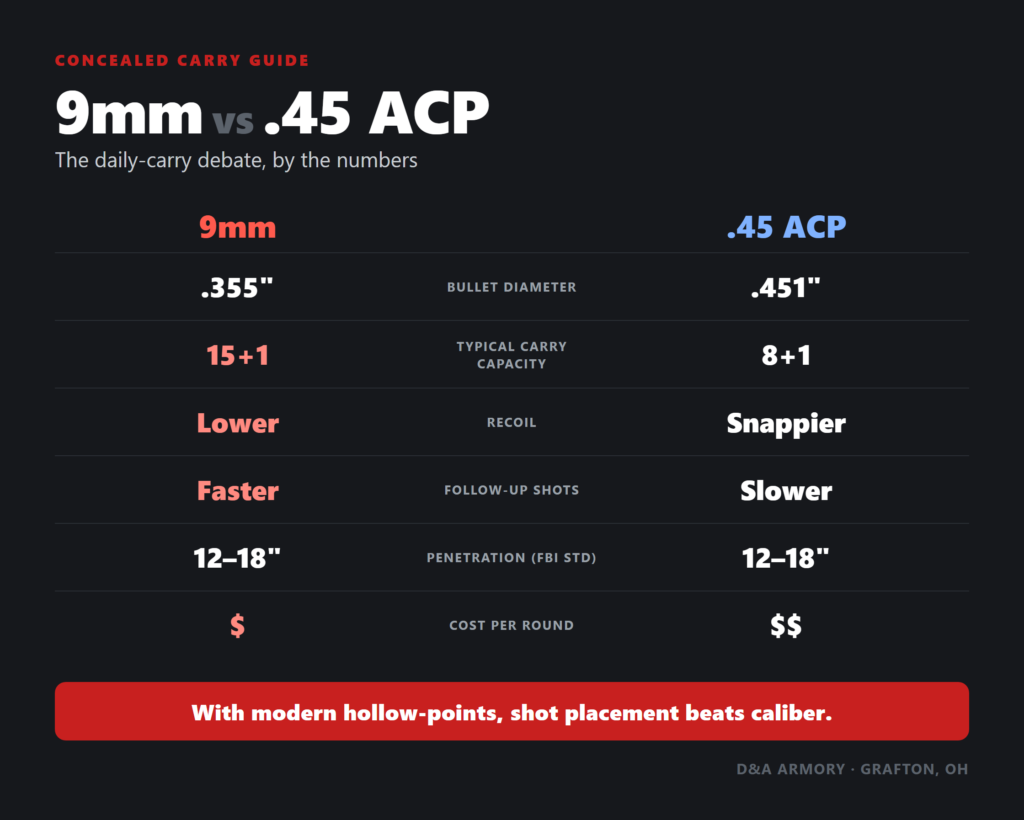
This one isn’t close. Because 9mm cartridges are physically smaller, you can fit far more of them in the same-size magazine. A full-size Glock 17 holds 17+1 rounds of 9mm; a compact Glock 19 holds 15+1. Compare that to a .45 ACP Glock 21 at 13+1, or a classic 1911 that typically carries just 7 or 8. The gap is even wider in the tiny pistols people actually carry every day: a micro-compact like the SIG P365 packs 10 to 12+ rounds of 9mm into a gun small enough to vanish in a pocket — where most .45s can only manage 6 or 7. In a defensive encounter, more rounds means more margin for misses and more capability against multiple threats, all before you ever have to reload.
Round 2: “Stopping Power” and the Modern-Ammo Reality
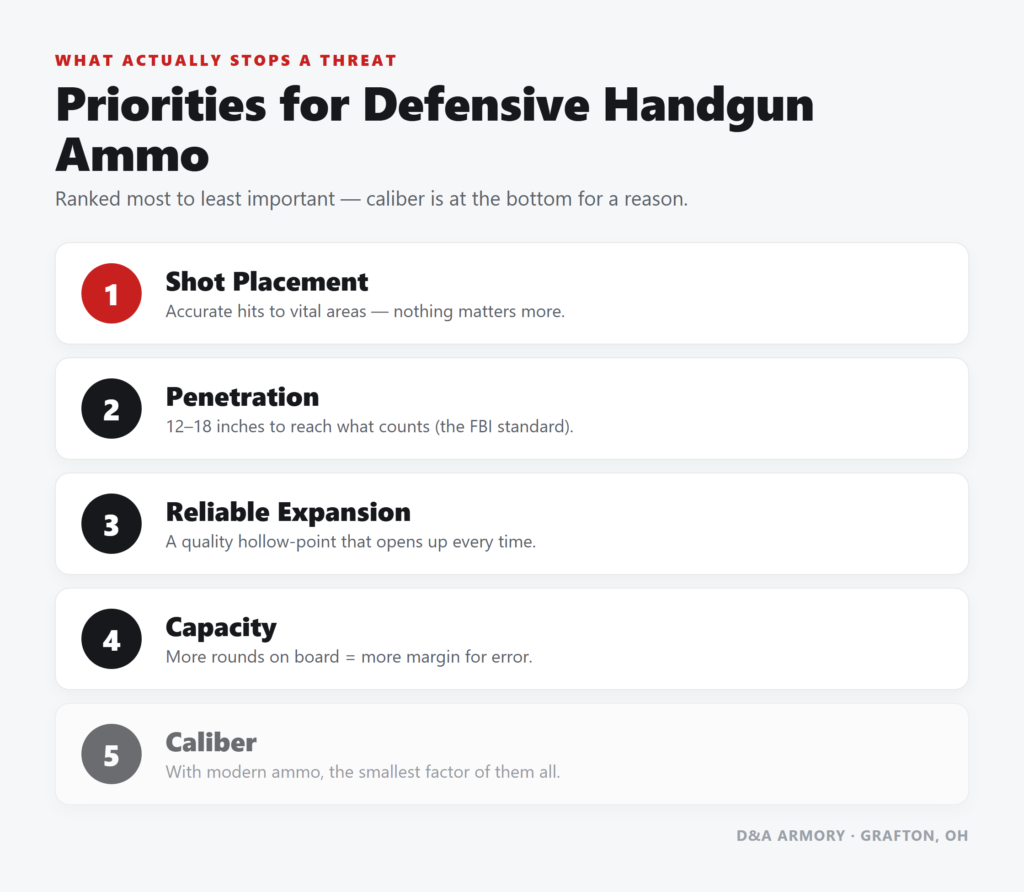
Here’s where the old wisdom breaks down. Decades ago, when most defensive ammo was simple round-nose “ball,” bigger bullets genuinely did make bigger holes. But today’s premium self-defense loads — think Federal HST, Speer Gold Dot, or Hornady Critical Duty — are engineered hollow-points that expand reliably to nearly double their diameter and penetrate to the depths that matter. Quality 9mm, .40, and .45 loads all routinely meet the FBI’s benchmark of 12 to 18 inches of penetration in ballistic gel. The honest takeaway most experts will give you: with modern ammunition, the terminal-performance difference between service calibers is far smaller than the marketing suggests. As the FBI itself has put it, handgun “stopping power” is largely a myth — no pistol round reliably ends a threat with a single shot.
Round 3: Recoil, Follow-Ups, and Shot Placement
If capacity is 9mm’s biggest win on paper, controllability is its biggest win in the real world. The .45 ACP’s heavier bullet produces more felt recoil and muzzle rise, which slows your ability to get back on target for a fast, accurate second shot. The 9mm’s lighter recoil lets most shooters put rounds on target faster and more precisely — and that matters enormously, because shot placement is the single most important factor in stopping a threat. A well-placed 9mm hit beats a poorly-placed .45 every time. It’s exactly why so many trainers say the caliber debate is a distraction from the thing that actually wins fights: hits.
The best defensive caliber is the one you can shoot fast, accurately, and comfortably — under stress.
What the FBI Decided
You don’t have to take our word for it. In 2015, after exhaustive testing, the FBI officially transitioned its agents back to 9mm — a decision that made waves across the industry. Their reasoning, laid out in a widely-cited report, was straightforward: modern 9mm ammunition performs comparably to larger calibers in terminal testing, while offering higher capacity, less recoil, faster and more accurate shooting, and lower training costs. When the agency that helped define handgun-ammo testing standards chooses 9mm, it’s worth paying attention.
Cost and Training Time
There’s a practical dimension people forget. 9mm is typically the most affordable centerfire pistol cartridge on the shelf, while .45 ACP usually costs noticeably more per round. That difference adds up fast — and it directly affects how often you can afford to practice. Since skill and shot placement are what actually keep you safe, the cheaper round that gets you to the range more often has a real, measurable edge.
So… Which Should You Carry?
For most people, most of the time, 9mm is the smart, modern choice: more rounds, easier to shoot well, cheaper to train with, and — with quality defensive ammo — no meaningful drop in effectiveness. That said, the .45 ACP is far from obsolete. If you shoot it accurately, carry it confidently, and don’t mind the lower capacity and higher cost, it’s still a proven, capable defensive round. The worst choice is a caliber you flinch with or won’t practice with. Carry the gun and load you’ll actually train with and can shoot well under pressure.
Come Try Both at D&A Armory
The best way to settle the debate for yourself is to put both in your hands. Stop by D&A Armory in Grafton, and our team will walk you through 9mm and .45 ACP options, help you find a carry pistol that fits your hand and your lifestyle, and point you toward quality defensive ammo and training to match. Not sure where to start? That’s exactly what we’re here for.
This article is for general educational purposes and isn’t legal advice. Always follow all federal, state, and local laws regarding firearms and concealed carry, and seek qualified, in-person training.

Leave a Reply
You must be logged in to post a comment.